2026 Rules of Golf Explained: Key Updates Every Golfer in Kenya Should Know

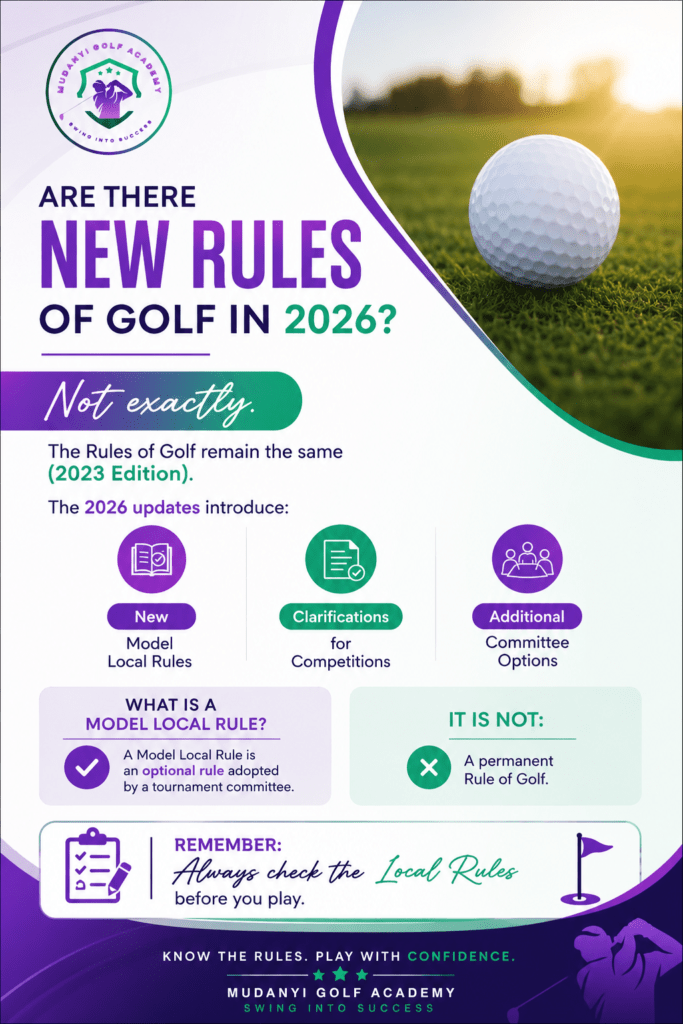
Golf is a game built on integrity, precision, and respect for the Rules. While many players expected sweeping changes to the Rules of Golf in 2026, the reality is more practical—and equally important. Rather than introducing an entirely new rulebook, the R&A and USGA have released a series of updated Model Local Rules and clarifications that came into effect on 1 January 2026.
For golfers in Kenya, understanding these updates is essential. Whether you’re a junior golfer, amateur competitor, parent, coach, or caddie, knowing when and how these Local Rules apply can make the difference between a great round and an unnecessary penalty.
At Mudanyi Golf Academy, we believe that great golfers are not only technically skilled but also knowledgeable about the Rules that govern the game. This guide explains the most important 2026 updates and what they mean for golfers competing across Kenya.
Understanding the Rules of Golf and Local Rules
The Rules of Golf are jointly governed worldwide by the R&A and the United States Golf Association (USGA). In Kenya, competitions follow this framework through organizations such as the Kenya Golf Union (KGU), the Junior Golf Foundation (JGF), and individual golf clubs.
One of the most important things every golfer should understand is that Local Rules are optional. They do not automatically apply to every round of golf. Instead, each tournament committee decides whether to adopt specific Local Rules based on the course and competition.
Before every competition, players should always read:
- The Terms of Competition
- The Local Rules sheet
- Notice boards or starter instructions
- Any announcements from the tournament committee or referee
One simple question can prevent costly mistakes:
“Is this Local Rule in effect today?”
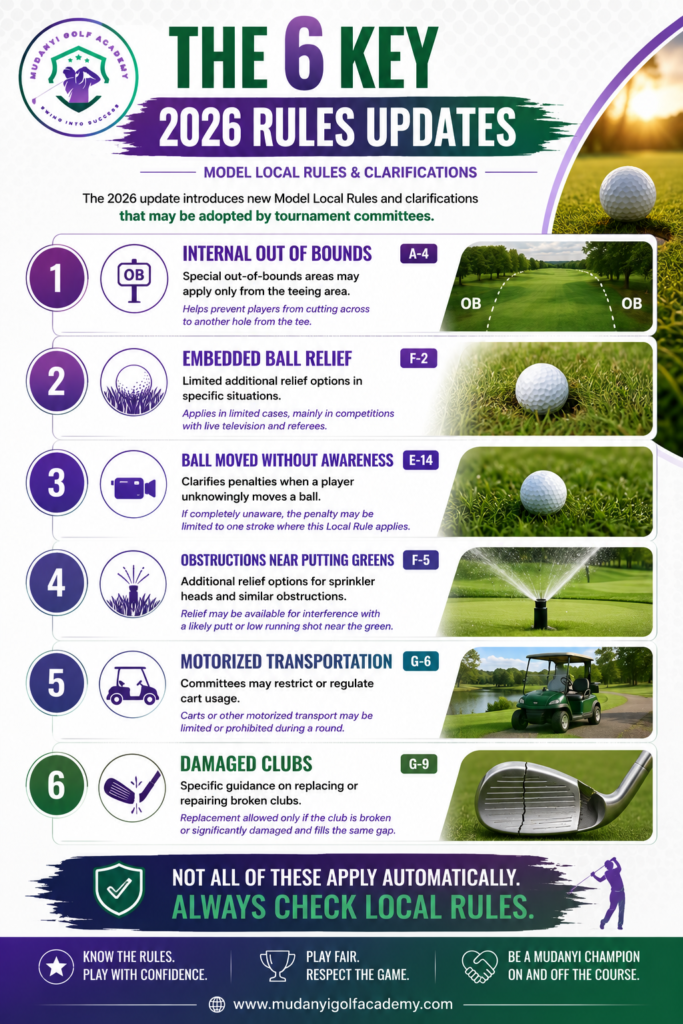
Key 2026 Rules of Golf Updates
1. Internal Out of Bounds Can Apply Only to Tee Shots
One of the biggest updates gives tournament committees greater flexibility when defining internal out of bounds.
Previously, internal out of bounds generally applied throughout the entire hole. Under the new Model Local Rule, committees can choose to make these boundaries apply only to strokes played from the teeing area.
This is particularly useful on dog-leg holes where players may attempt to cut across another fairway or where safety is a concern.
What this means for golfers:
Never assume white stakes apply throughout the hole. Always check the Local Rules before your round.
2. Ball Moved Without the Player Knowing
Another important clarification addresses situations where a player unknowingly causes their ball to move before making a stroke.
Normally, failing to replace a moved ball could result in playing from a wrong place. However, if the Local Rule is adopted and the player genuinely had no knowledge that the ball moved, the penalty may be reduced to one penalty stroke, rather than the more serious penalty for playing from a wrong place.
This clarification mainly benefits elite competitions where television cameras may detect tiny ball movements that players cannot reasonably see.
Player takeaway:
If you think your ball may have moved, stop immediately and ask for a ruling instead of continuing to play.
3. Expanded Relief for Embedded Balls
The 2026 updates also introduce an additional Local Rule concerning embedded balls.
In limited circumstances, a referee may allow relief when a player’s ball comes to rest below ground level inside an unrepaired pitch mark created by another player’s shot.
This Local Rule is primarily intended for professional tournaments with referees and television coverage, meaning it is unlikely to appear in most club competitions.
Player takeaway:
Learn the standard embedded ball Rule first. Do not assume additional relief applies unless it is specifically listed in the Local Rules.
4. Relief Near Putting Greens
Many golfers are familiar with relief from sprinkler heads located close to putting greens.
The updated Model Local Rule allows committees to extend similar relief to certain Ground Under Repair areas located near greens.
This helps preserve course conditions while giving players fair relief when playing delicate shots around the putting surface.
Player takeaway:
Interference with your line of play does not automatically entitle you to free relief. Relief is available only when the applicable Local Rule has been adopted.
5. Motorized Transportation During Competitions
The Rules of Golf generally allow motorized transportation unless a committee decides otherwise.
The 2026 Rules of Golf clarification recognizes that players may occasionally accept a ride believing it has been officially authorized. In certain situations, the committee may use discretion if the player reasonably accepted transportation by mistake.
This update is particularly relevant in Kenya, where some golf courses feature long distances between holes, steep terrain, or extreme weather conditions.
Player takeaway:
Always confirm with a tournament official before accepting a lift or using a golf cart during competition.
6. Replacing Broken or Damaged Clubs
Another update affects competitions that adopt Model Local Rule G-9.
When this Local Rule is in force, players replacing a broken club must choose a similar replacement that maintains the normal progression of their set. For example, replacing a damaged 5-iron with an additional driver would not be permitted.
Players may also use replacement components already being carried during the round to repair damaged clubs.
This Rule is mainly intended for elite competitions.
Player takeaway:
Understand the difference between the standard equipment Rules and additional Local Rules used in higher-level tournaments.
Other Important Clarifications
Practising Before a Stroke Play Round
Practice involves more than hitting golf shots.
Testing the speed of greens by rolling a ball or rubbing the putting surface may also count as practice when prohibited by the Rules.
Junior golfers should always warm up only in designated practice areas before competition.
Returning Your Scorecard
Competition committees may now define exactly when a scorecard is officially returned.
Some events may allow a short correction period after players leave the scoring area, while others may not.
Before submitting your scorecard:
- Verify every hole score.
- Check calculations.
- Ensure both player and marker have signed the card.
- Confirm the competition’s scorecard return procedure.
Why These Updates Matter for Golfers in Kenya
Every golf club in Kenya has unique course conditions and Local Rules.
A Local Rule used at one club may not exist at another.
Whether you’re competing in:
- Kenya Golf Union events
- Junior Golf Foundation tournaments
- Club competitions
- Inter-school championships
- Corporate golf days
- Open amateur championships
…always take time to read the Local Rules before teeing off.
Making assumptions can easily lead to unnecessary penalties.
How Mudanyi Golf Academy Prepares Players
At Mudanyi Golf Academy, Rules education is just as important as developing a great golf swing.
Rather than relying only on classroom learning, our coaching includes practical, on-course scenarios that help players understand how Rules apply during real competitions.
Players learn how to:
- Interpret Local Rules correctly.
- Identify when relief is available.
- Understand penalty situations.
- Return scorecards properly.
- Call for rulings when unsure.
- Develop confidence during tournament play.
This practical approach helps our students become smarter, more disciplined, and competition-ready golfers.
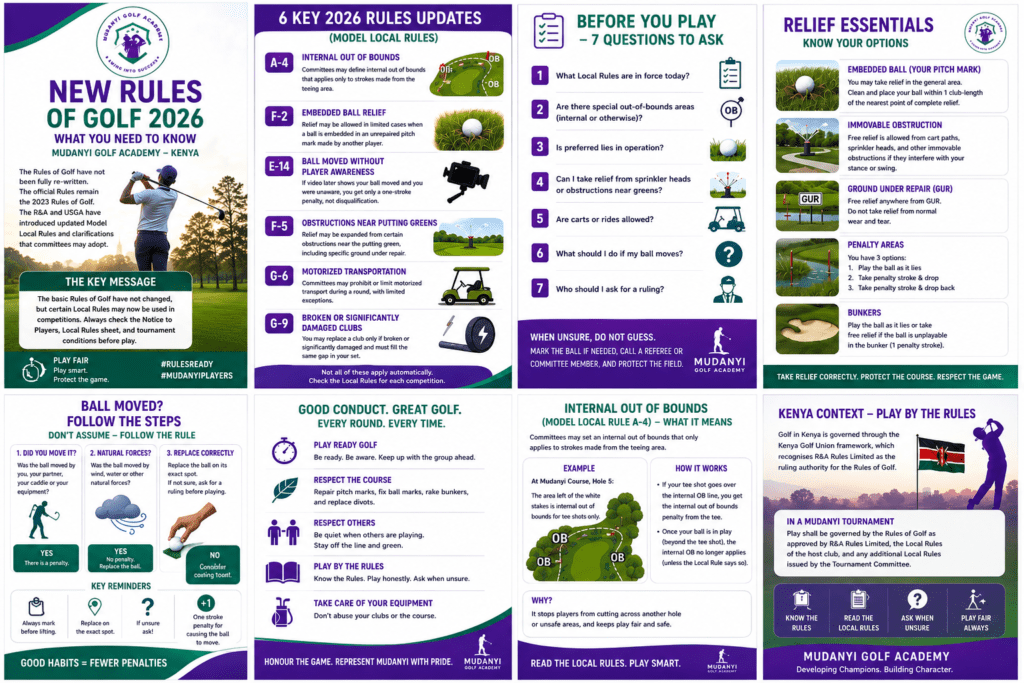
A Simple Checklist Before Every Competition
Before you play any tournament, ask yourself:
- What Local Rules apply today?
- Are there any internal out of bounds areas?
- Are golf carts permitted?
- Are there special relief procedures near the greens?
- Where are Ground Under Repair areas?
- What is today’s scorecard return procedure?
- Who is the Rules Official?
- What should I do if I’m unsure?
The best answer is always the same:
Stop, protect the field, and ask for a ruling.
Conclusion
The 2026 Rules of Golf are not a complete rewrite of the game. Instead, they provide practical updates and additional Model Local Rules that help competition committees manage tournaments more effectively.
For golfers, the biggest lesson is simple: know the Rules, understand the Local Rules, and never assume they apply unless the committee has adopted them.
At Mudanyi Golf Academy, we are committed to developing golfers who combine technical excellence with integrity, confidence, and a deep understanding of the game. By staying informed about the latest 2026 Rules of Golf, our players are better prepared to compete successfully at every level—from junior events to national championships.
Whether you’re just beginning your golf journey or preparing for your next tournament, learning the Rules is one of the smartest investments you can make in your game.